Adapting The Odyssey is a challenge. And yet, the epic poem by Homer seems to be especially close with the cinema industry seeing as already in 1905, George Melies was paying tribute to it with The Mysterious Island. A hundred and twenty years – the speech, colors and quite a few other adaptations later – it is Christopher Nolan’s turn to orchestrate Odysseus’ journey. And Nolan thinks on a grand scale for his first fantastic movie since he films it exclusively with IMAX cameras. A rare 70mm film format, expensive and challenging but which puts the film – long left behind since the digital arrival – back in the center of cinephile debates.
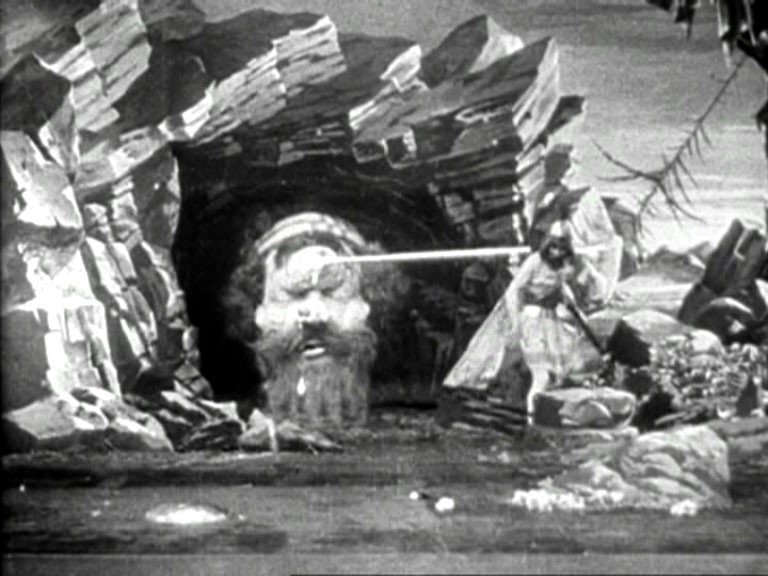 Image taken from the 1905 film Calypso by George Méliès
The news of a movie filmed entirely in IMAX made a lot of noise among the fans. You probably saw comparisons of format between a normal theater diffusion and a 70mm IMAX equipped theater diffusion. However these theaters are very rare : only about thirty in the whole world. And even if a theater opened a room specially for The Odyssey in Montpellier, it’s to Brussels that we went to see the movie in the conditions it was filmed to watched in.
The result is striking by its materiality and how immersive it is. The 70mm film offers a large image quality as well as the vulnerability of the grain and the potential dust of the film roll. It allows a very particular work on the colors with a dark calibration with a certain contrast. And, obviously, the IMAX screen format changes entirely the film’s perception and its giantism. Odysseus lost in the desert of the screen. Agamemnon’s imposing build which dominates the frame. The horrors of Odysseus’ encounters. The devastation of Troy. Penelope surrounded by suitors. In standard format, the main elements of The Odyssey are cropped along with the image, creating a distance between the narrative and the viewer. The movie’s key scenes are downplayed and its flaws are highlighted.
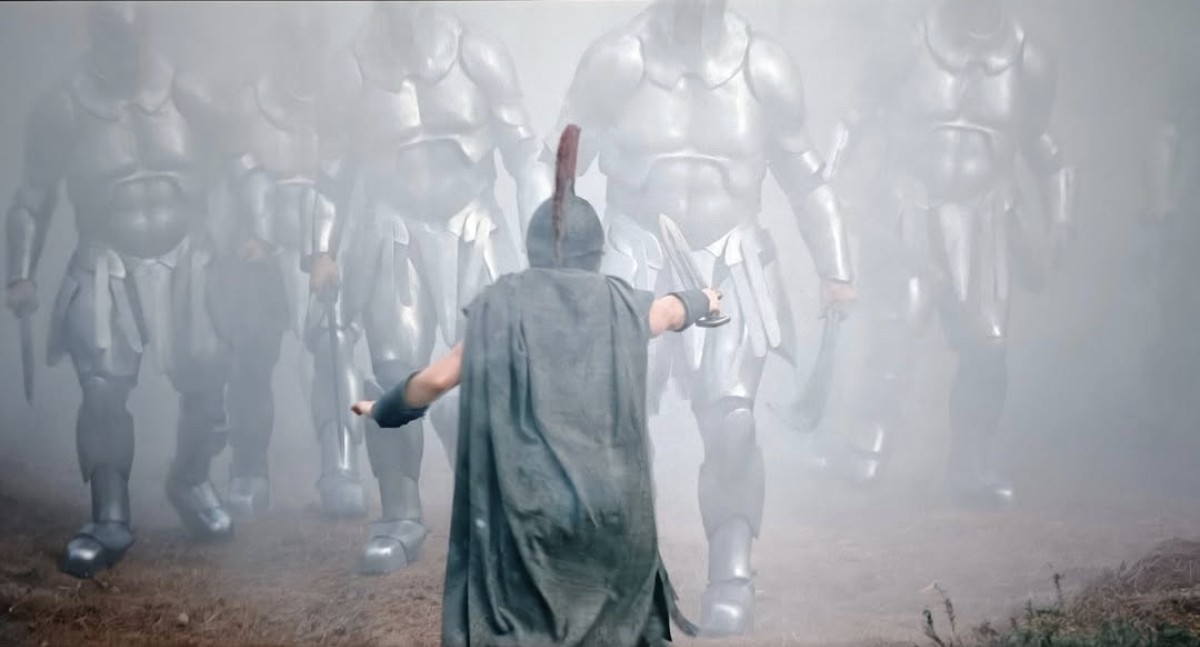
35mm : Odysseus
in the center of the image, standing strong against the almost
ghostly Laestrygonians.
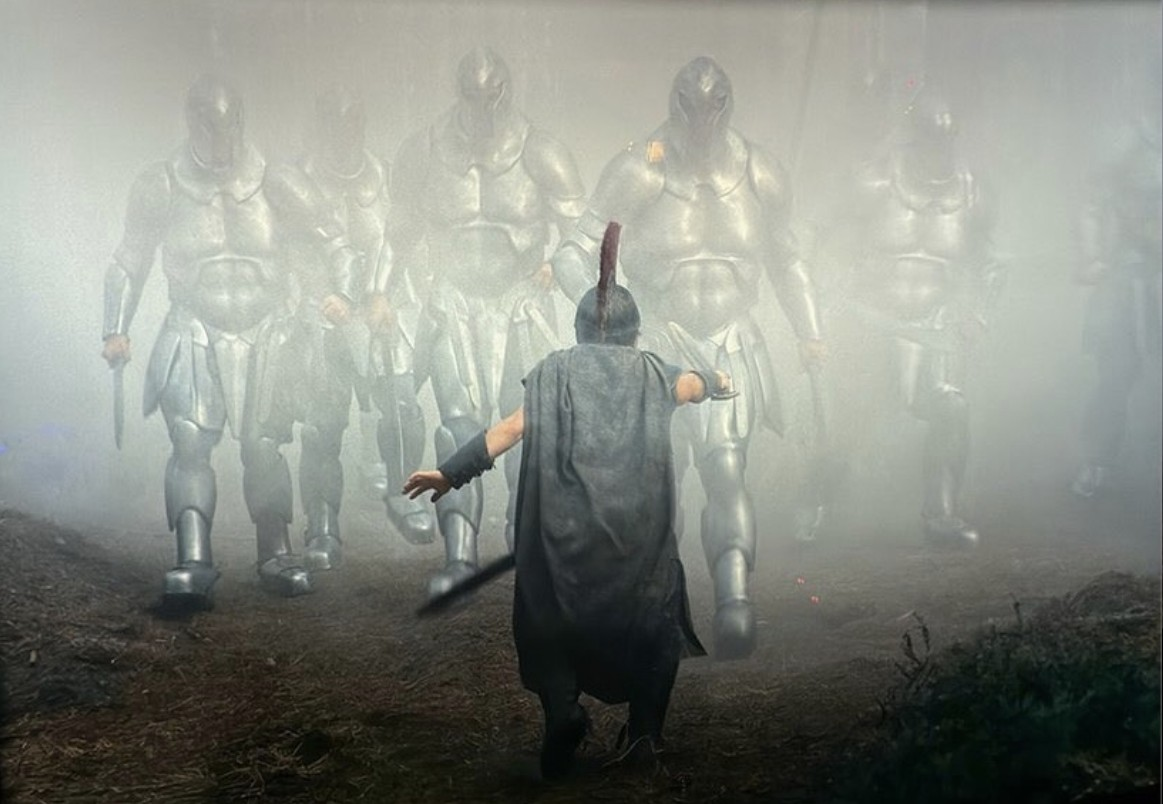 70mm : Odysseus, overwhelmed by the menacing Laestrygonians, is fleeing. This
format allows you to see the positioning of his legs and the heads of
his adversaries.
70mm : Odysseus, overwhelmed by the menacing Laestrygonians, is fleeing. This
format allows you to see the positioning of his legs and the heads of
his adversaries.
But that materiality of the
film has a price. On set, the IMAX camera is very limiting compared
to the digital cameras, which have become the norm on sets. It’s
noisy and so is equipped with an isolation box, which adds even more
volume to its build. Not very easy to handle, she causes a real issue
when filming dynamic shots. Its stature is also a problem for
dialogues. The actors can not see each other anymore since the camera
is blocking their field of view and it is difficult to film close-ups
from the front. Nolan's team, led by Hoyte van Hoytema - Spike
Jonze's cinematographer on Her
and a longtime collaborator of Nolan's since Interstellar
- set up a mirror
system to position themselves as close as possible to the characters,
thereby minimizing this limitation. The IMAX camera is also not very
autonomous in film : the number of possible takes is limited and the
shots can not be too long. Contrary to the external memories of the
digital cameras, the IMAX camera has a very restricted storage
possibility and is defined by the film roll.
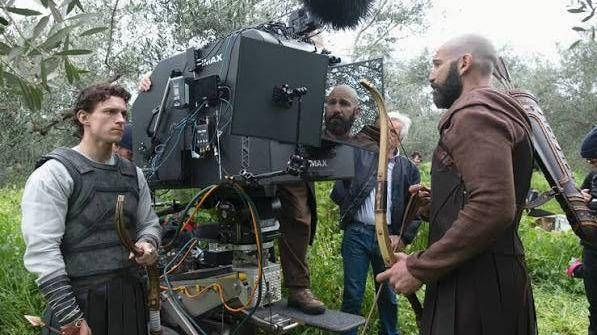
Image of a dialogue sequence using this technique during filming
And once the film roll is taken
back, how to edit it ? Christopher Nolan didn’t work himself
directly on the film roll. After the shooting, it is digitized and it
is this digital copy that he handled, cut, calibrated etc using
editing software that tracks frame number and the modifications to
apply on the film roll. The data is then sent to a specialized
laboratory that physically shows the film roll. The latter will then
be copied, digitized and sent to be distributed worldwide.
The last constraint of the IMAX format is its distribution. The lack of
70mm IMAX theaters deprives the majority of viewers of the original
images of the film. And rather than blaming the director for this
format choice, one should rather take issue with the large
screening complexes that, instead of investing in IMAX 70mm, preferred
to invest in other special theaters - the usefulness of which can be questioned - such as 4DX (moving seats, water projection…)
or ScreenX (extension of the screen onto the side walls).
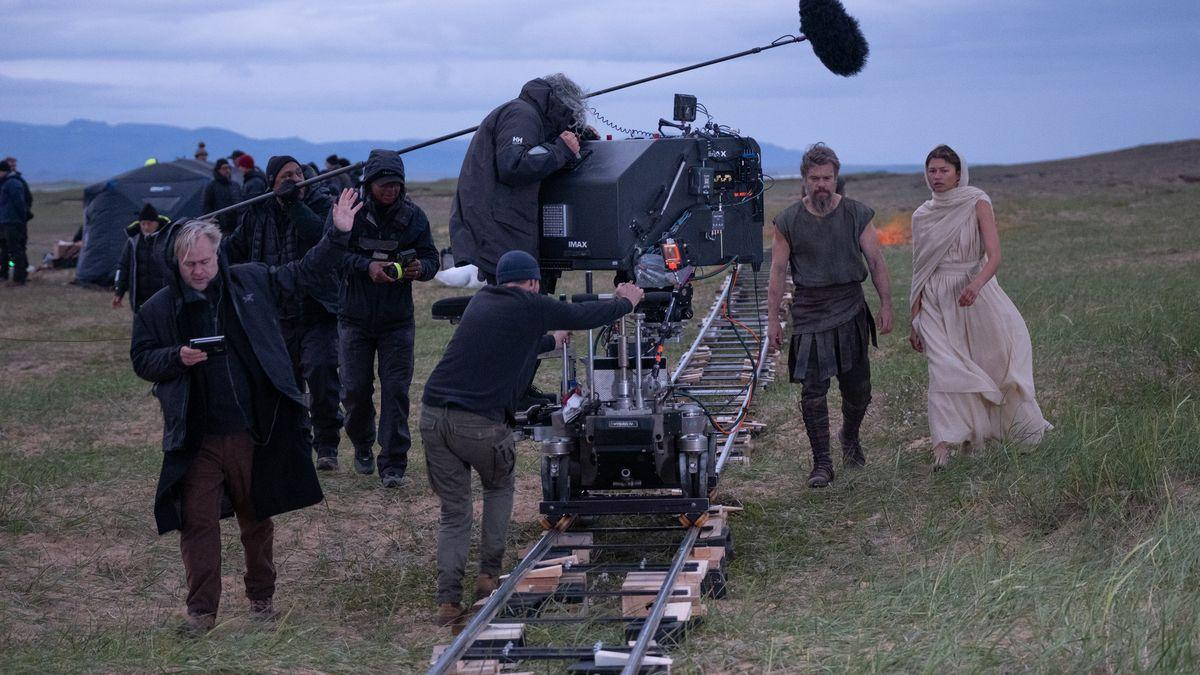 Image of the system specially designed to soundproof the IMAX 70mm camera
With The
Odyssey, Nolan shows
that film roll is not an outdated format. Its visual quality is well
liked and the screening is popular among cinephiles who sometimes
travel to another country to see the movie. The media phenomenon also
allows to tease the curiosity of an audience less used to movie
theatres and encourages it to question the physical format. The film
roll is not dead and Nolan is a moviemaker who is giving it a fresh
start. The Odyssey initiates the great return of film roll, which can
be considered a reaction to the over-dematerialization of cinema and
of art in general. A point of view brought by Olivier Corvée, a film
projectionist at the Cinémathèque Universitaire - the only movie
theatre in France that still screens movies of film roll daily,
located at the Sorbonne Nouvelle - whom we interviewed for a
documentary that will be released on our YouTube channel. Film roll
just like vinyl has that vintage attraction and maintains itself
alive by those 70mm screening events that initiate its return.
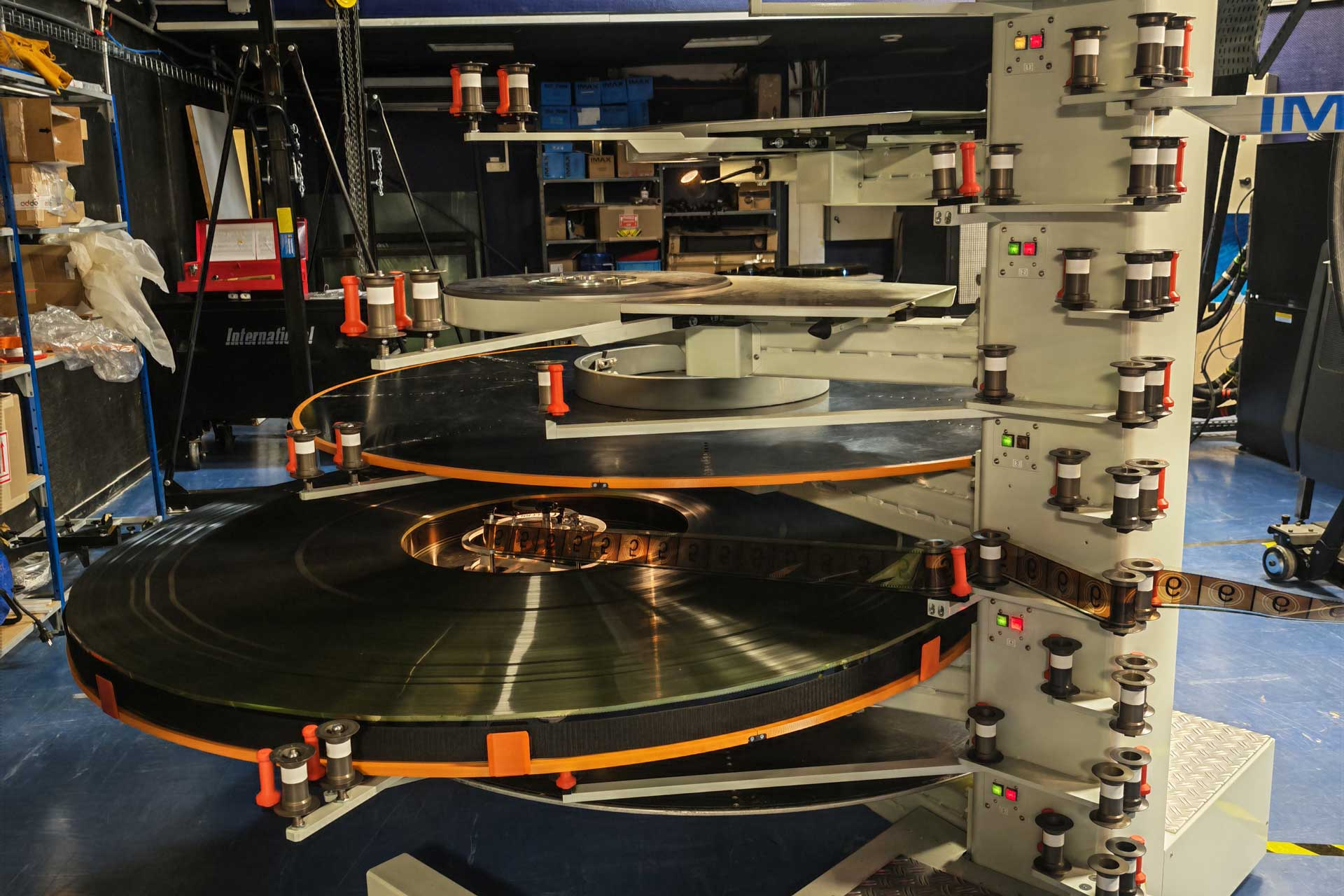 Film roll of The Odyssey
loaded on the 70mm projector in Montpellier
Film roll of The Odyssey
loaded on the 70mm projector in Montpellier
Thanks for reading this article ! And you ? Are you more of a 35mm or IMAX 70mm fan, even with the price ? Let us know what you think in the comments and share this post with your loved ones !
Translated by Mathilde Rivière